How To Replace Governor On Kohler Engine – Full Guide
To replace the governor on your Kohler engine, start by gathering two 7/16 wrenches, vice-grips, and a torque wrench. Confirm the engine is off and cool, then carefully disconnect the throttle cable and loosen the governor arm.
Remove related parts like the air filter and governor cover, then pull out the old governor shaft. Install the new governor, reattach linkages exactly as before, and adjust spring tension to regulate RPM around 4,000.
A thorough approach guarantees smooth operation and reliable control. Keep following for detailed steps.
Gather Tools for Governor Replacement
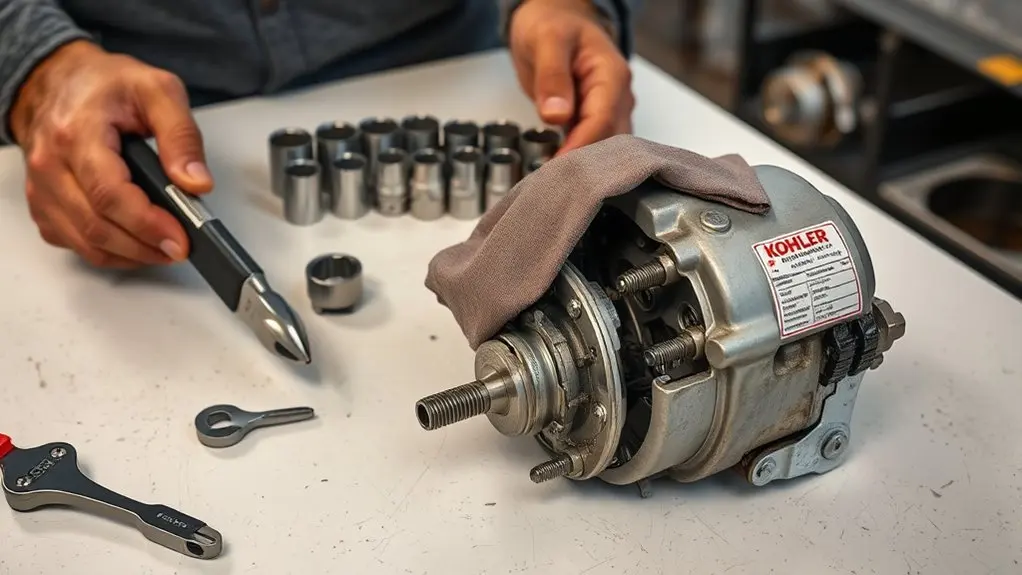
To replace the governor on your Kohler engine, you’ll need at least two 7/16 inch wrenches to loosen and tighten bolts securely. A small pair of vice-grips is essential for holding the shaft steady during adjustments, preventing unwanted movement.
Set up a clean, well-lit workspace to access engine components easily and reduce errors. Having a torque wrench guarantees you tighten all bolts to the manufacturer’s specifications, which is critical for reliable operation and avoiding damage.
Finally, keep a Kohler engine manual or model-specific guide nearby for precise instructions and torque values. Gathering these tools beforehand streamlines the replacement process and helps maintain the engine’s performance and safety.
Safely Disconnect the Old Governor
Before disconnecting the old governor, make certain the engine is off and completely cooled to prevent injuries.
Begin by documenting the governor linkage positions and connections; this will simplify reinstallation.
Use a 7/16 inch wrench or the appropriate tool to loosen the clamp securing the governor arm and related linkages.
Carefully detach the throttle cable and governor arm from the governor to avoid damaging these components.
Once disconnected, inspect the old governor for wear or damage, which may explain any prior performance problems.
Handle all parts cautiously to maintain their condition for reference or reuse.
Following these steps guarantees a safe, precise disconnection and prepares you for the next phase of replacing the governor on your Kohler engine.
Remove Governor Linkage and Related Parts
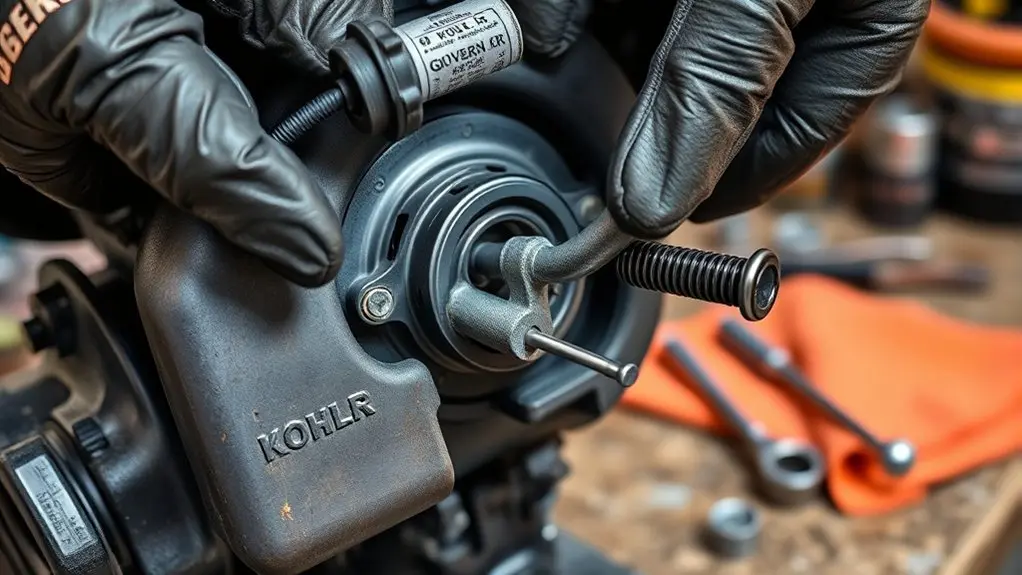
Disconnect the throttle cables and all linkages attached to the governor to gain unobstructed access to the assembly.
Next, remove the air cleaner cover and air filter to clear the workspace around the governor.
Unscrew and carefully take off the governor’s protective cover, keeping track of all fasteners.
Observe and note the exact position of the governor arm before detaching it from the governor shaft; this guarantees proper alignment during reassembly.
Once detached, gently pull the governor shaft out of the engine block, freeing it from any remaining connections or obstructions.
Handle components carefully to avoid damage.
Completing these steps thoroughly prepares you to proceed with removing the old governor and installing the replacement without complications.
Install the New Governor on Kohler Engines
With the old governor removed and the shaft cleared, you’re ready to install the new governor on your Kohler engine. Start by removing any components blocking access to the governor assembly to guarantee a clear workspace.
Align the new governor with the shaft carefully, then secure it using the appropriate fasteners tightened to the manufacturer’s specifications.
Next, reattach the governor linkage to the carburetor, making sure it moves freely and engages properly to control throttle response.
Confirm all connections match the original setup for accurate operation.
Finally, once installed, conduct a test run of the engine to verify the governor functions correctly. This step confirms the installation integrity before proceeding to adjust the governor for proper RPM settings.
Adjust the Governor for Proper RPM Settings
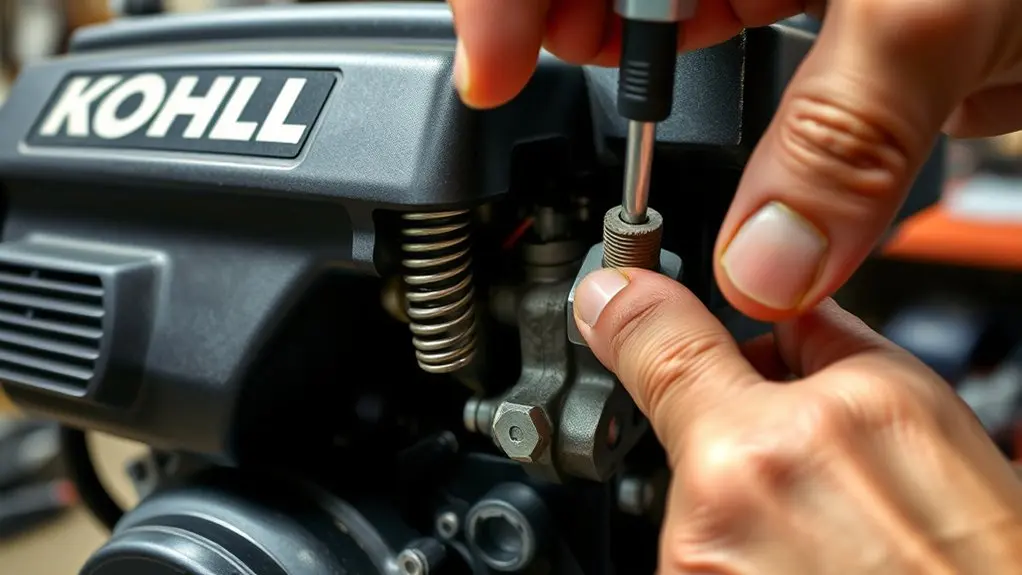
First, make sure the governor arm moves freely without any binding in the linkage to the carburetor.
If it feels tight or stuck, you’ll want to check the connections carefully. You can adjust the spring tension or move it to different holes to fine-tune the RPM settings.
Just keep in mind, it’s best to set the RPM a bit below the maximum limit to keep things safe and running smoothly.
Governor Arm Adjustment
Verify the linkage between the governor arm and the carburetor moves freely before making any adjustments.
Start by loosening the clamping bolt on the governor arm to access the adjustment point.
Next, clamp vice-grips onto the shaft passing through the governor arm and rotate it counter-clockwise until it stops. Then, pull the governor arm to position the carburetor fully open.
Once aligned, tighten the clamping bolt securely to lock the adjustment.
Finally, fine-tune the governor arm’s spring tension to set the proper RPM, ensuring you comply with pulling rules and maintain safety margins.
This precise adjustment guarantees stable engine speed and reliable performance under varying loads, preventing overspeed and mechanical damage.
RPM Setting Techniques
Adjusting the governor to achieve proper RPM settings requires careful manipulation of the spring tension on the governor arm. To increase RPM, tighten the spring or move it downward in its holes. To decrease RPM, loosen the tension or shift the spring upward.
Set the maximum RPM around 4,000 to comply with pulling rules and avoid disqualification. Aim for roughly 3,950 RPM to maintain a safe margin.
Since Kohler engines lack onboard computer controls, you’ll need to manually fine-tune RPM settings with precision. Regularly check and maintain the governor to guarantee consistent performance during pulling events.
Monitor RPM closely during adjustments to attain peak engine speed, ensuring reliable operation and adherence to competition standards.
Test Engine Performance After Replacement
Once you start the engine, take a moment to check the throttle response.
Make sure it adjusts smoothly across all RPMs. Keep an eye on the RPM as well to confirm it stays close to the target range, which is around 3,950 RPM.
Finally, test the engine under load and verify that the governor keeps the speed steady during operation.
Initial Startup Checks
Before you start the engine after replacing the governor, make sure all connections are secure and properly aligned to prevent any operational issues. Start the engine and listen closely for unusual noises or vibrations.
Let it warm up for a few minutes while monitoring throttle response at varying RPMs. Use a tachometer to verify the governor maintains correct RPM settings within safe limits.
Finally, confirm the engine shuts off promptly when throttled to idle or when safety features engage.
| Checkpoint | What to Observe |
|---|---|
| Connections | Secure, properly aligned |
| Engine Running | Smooth operation, no odd sounds |
| RPM Regulation | Consistent with tachometer readings |
| Safety Shutdown | Engine stops at idle or safety trigger |
Throttle Response Testing
A thorough throttle response test verifies your Kohler engine accelerates smoothly and consistently after replacing the governor. Gradually apply throttle while listening for unusual noises that could signal improper installation or mechanical issues.
Use a tachometer to measure RPM, confirming it stays near 3,950 RPM for pulling applications. Observe engine behavior under varying load conditions to ensure the throttle reacts accurately without hesitation or stalling.
Document all throttle response data to compare with pre-replacement performance. This helps identify any lingering problems. This systematic testing verifies the governor replacement achieves peak engine performance, preventing unexpected failures during operation.
Following these steps precisely will help you verify that the throttle control functions correctly and the engine responds reliably to input changes.
RPM Stability Verification
To verify RPM stability after replacing the governor, start your Kohler engine and let it warm up to reach steady operation.
Use a tachometer to measure RPM, confirming it stays near 3,950 RPM, the ideal range for pulling compliance.
Observe throttle response during acceleration to ensure the governor manages speed smoothly without stalling. Conduct tests at multiple throttle positions to assess performance consistency.
Note any RPM fluctuations or deviations from expected values, as these may signal the need for governor adjustment or reveal installation issues. Recording these readings helps pinpoint irregularities and guarantees reliable engine operation.
Troubleshoot Common Governor Issues
Three common governor issues you’ll encounter on Kohler engines include lack of throttle response, erratic engine revving, and improper RPM regulation. Start troubleshooting by inspecting the governor linkage for seizure or incorrect adjustment, as these often cause throttle issues.
Check the governor arm’s movement; it should move freely without binding. Erratic revving usually signals worn or damaged linkage components, so examine for play or wear. Adjust spring tension to maintain proper RPM limits, ensuring the engine runs smoothly.
If problems persist, disconnect the governor temporarily and test engine response with a direct throttle cable to isolate the fault. Keep a detailed log of all adjustments and engine behavior to identify patterns and guide future maintenance.
This methodical approach helps restore reliable governor function efficiently.
Frequently Asked Questions
What Type of Oil Is Best for Kohler Engines With New Governors?
You should use high-quality synthetic oil with SAE viscosity ratings like 10W-30 or 5W-30 for Kohler engines with new governors. This guarantees peak performance across various temperatures.
Make sure the oil meets API service classifications such as SF, SG, SH, SJ, or SL to ensure proper lubrication and protection.
Regularly check oil levels and change it every 50 hours or as recommended to maintain engine efficiency and protect new governor components.
How Often Should the Governor Be Inspected or Replaced?
You should inspect the governor on your Kohler engine every 50 hours of operation to guarantee it maintains proper RPM control.
If you notice erratic engine speed or throttle issues, check it immediately.
Replace the governor if it wobbles or fails to return to idle, as this affects safety and performance.
Heavy engine use may require more frequent inspections and replacements to prevent costly damage and guarantee reliable operation.
Can a Governor Cause Engine Overheating if Malfunctioning?
Can you imagine your engine running uncontrolled at high speeds? Yes, a malfunctioning governor can cause engine overheating by failing to regulate RPMs properly.
When the governor sticks or misadjusts, it leads to excessive engine load and a lean fuel mixture, both increasing combustion temperatures.
This elevated heat stresses engine components, risking damage. You need to inspect and maintain the governor regularly to prevent overheating and guarantee your engine runs efficiently.
Is It Necessary to Recalibrate the Carburetor After Replacing the Governor?
Yes, you need to recalibrate the carburetor after replacing the governor. The new governor changes how the throttle controls engine speed, which affects the fuel-air mixture needed.
Without recalibration, the engine might run inefficiently or even stall. So, adjust the idle speed and throttle settings according to the manufacturer’s specs.
Always check the engine manual for the exact calibration steps after installing a new governor to ensure smooth performance.
What Are Signs of a Failing Governor Before Complete Replacement?
You’ll notice inconsistent engine speed and unexpected revving.
You’ll see fuel consumption creep up, signaling poor regulation. You’ll struggle to maintain steady RPMs, causing erratic performance.
You’ll hear unusual rattling or clattering noises from the governor area.
You’ll spot cracks or wear on the governor linkage during inspection. These signs tell you the governor’s failing and needs attention before complete replacement becomes urgent.
Conclusion
Replacing the governor on your Kohler engine guarantees peak performance and longevity. Did you know that a properly adjusted governor can improve fuel efficiency by up to 15%?
By following these steps—gathering tools, safely disconnecting the old governor, installing and adjusting the new one, then testing engine performance—you’ll maintain precise RPM control and avoid common issues.
Keep this guide handy for quick reference during maintenance or troubleshooting.