How To Test Stator On Kohler Engine – Quick Guide
To test the stator on your Kohler engine, first disconnect the positive battery cable and stator leads for safety. Use a multimeter set to ohms to measure resistance between 0.2 and 0.3 ohms, indicating a healthy winding.
Then, with the engine running, check AC voltage between 25 and 50 VAC across the leads. Low or inconsistent readings suggest issues with windings or connections.
Keep the stator well-maintained, and continue for tips on troubleshooting and upkeep.
Preparing Your Kohler Engine for Stator Testing
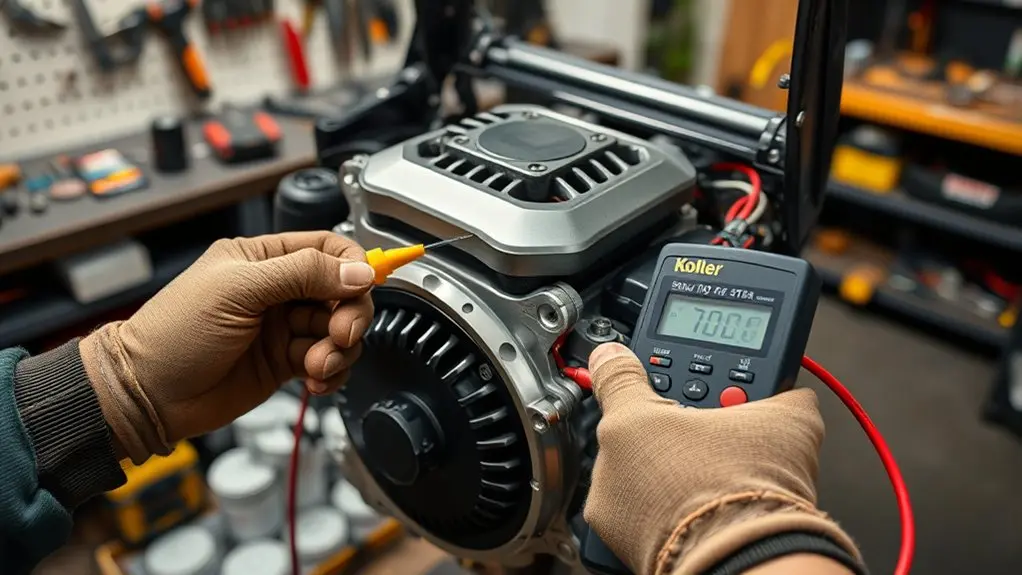
Before you start testing the stator on your Kohler engine, always disconnect the positive battery cable to guarantee safety. Whether you’re managing a new account or maintaining equipment that’s been running for several years, this step is vital to prevent accidental shocks.
Confirm the engine is off and cool before proceeding. Next, carefully identify and disconnect the stator leads from the rectifier regulator assembly to avoid interference with your readings.
Before testing, check the wiring for any visible signs of wear, corrosion, or loose connections, which can affect battery voltage and overall performance.
Inspect wiring for wear or corrosion to ensure accurate readings and optimal engine performance.
Taking these preparation steps guarantees you get accurate resistance measurements and helps maintain your engine’s reliability over time.
Multimeter Tools for Accurate Stator Resistance Measurement
After disconnecting the stator leads and inspecting the wiring, the next step is to use the right multimeter to measure the stator’s resistance accurately. Use a digital multimeter with multiple ohm settings, making certain it’s properly set for AC or DC resistance as required.
Measure resistance directly at the stator outputs after disconnecting from the rectifier regulator to avoid false readings. Check that your multimeter leads are in good condition and securely connected since poor connections can cause inaccurate results.
Typically, readings between 0.2 and 0.3 ohms indicate a healthy stator, while values near zero suggest a short circuit winding. If your readings show a short circuit, it’s best to replace the stator with a new one to guarantee reliable engine performance.
Measuring Kohler Stator Resistance Safely
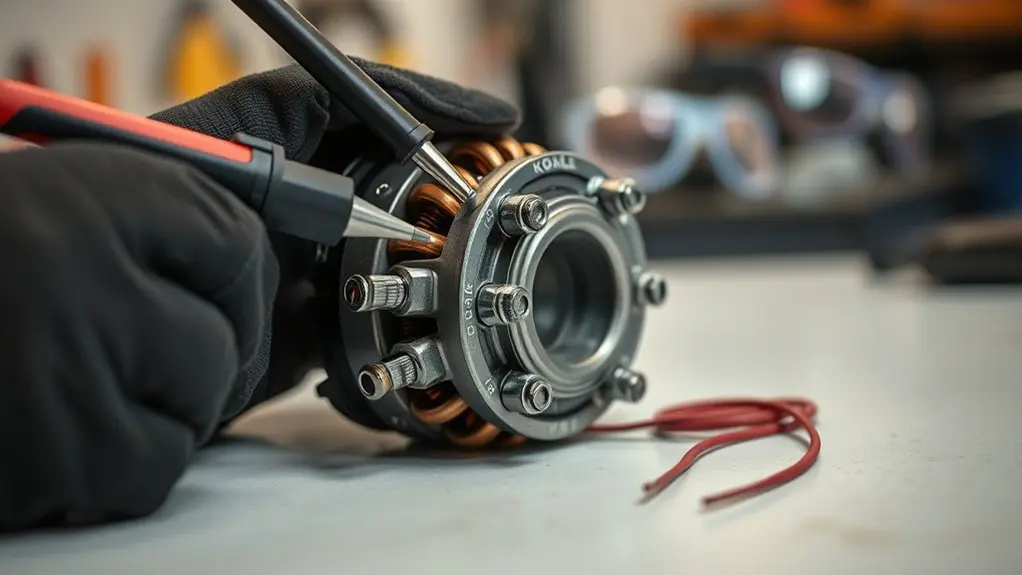
To measure the Kohler stator resistance safely, start by disconnecting the positive battery cable to eliminate any risk of electrical shock or damage.
Next, disconnect the stator leads from the rectifier regulator to avoid interference with your readings. Use a multimeter set to the ohms scale and measure across the stator leads.
You’re aiming for a resistance between 0.2 and 0.3 ohms; readings close to 0 indicate a short and mean the stator is faulty. Confirm you don’t get an over-range reading. That confirms no shorts exist between the leads and the core, showing good insulation.
Follow these steps:
- Disconnect the positive battery cable.
- Separate stator leads from the rectifier.
- Measure resistance with a multimeter.
- Inspect and clean connection points for accuracy.
Checking AC Voltage Output From Your Kohler Stator
Start your engine and grab your multimeter, setting it to AC mode.
Then, measure the AC voltage across the stator leads. You should see a voltage reading between 25 and 50 VAC when the engine is running at higher RPMs if the stator is healthy.
Now, if you notice that the voltage drops significantly when you apply a load, that could be a sign there’s an issue with either the stator or the rectifier.
Measuring Voltage Output
When you run your Kohler engine at higher RPMs, you can measure the AC voltage output from the stator to assess its condition.
Use a digital multimeter set to AC voltage mode for accurate readings.
Follow these steps: Run the engine at full throttle to reach ideal RPMs. Measure the voltage across the stator leads; it should be between 25-50 VAC.
If voltage is consistently below 25 VAC, suspect stator winding issues.
Connect the stator leads to the rectifier and check voltage again. If it drops considerably, the rectifier might be faulty.
Expected Voltage Range
Checking the voltage output from your Kohler stator gives you a clear picture of its health.
You should expect to see between 25 to 50 VAC when the engine runs at various RPMs.
If the voltage drops below 25 VAC, it may signal winding problems or other stator faults. Conversely, higher voltage readings confirm that the stator is producing enough power and help rule out low resistance concerns.
Always use a digital multimeter set to the correct AC voltage range for accurate results. Measure the voltage at different engine speeds, like idle and full throttle, to guarantee the stator’s output is stable and reliable across conditions.
This helps you assess whether the stator is functioning properly before moving on to further tests.
Testing Under Load
You’ll need a digital multimeter set to AC voltage to measure your Kohler stator’s output while the engine runs.
Follow these steps to test under load:
- Connect the multimeter leads to the stator wires with the engine running.
- Check that voltage reads between 25-50 VAC across different RPMs.
- Watch the voltage during acceleration. Stable readings at higher RPMs mean the stator is working properly.
- If voltage drops sharply when connecting to the rectifier, suspect a faulty rectifier, not the stator.
Testing under load helps catch winding issues early and guarantees your stator performs reliably, preventing unexpected failures.
Keep this process part of your regular maintenance routine.
Common Kohler Stator Problems and What They Mean
Voltage inconsistencies and grounding issues are the most common problems you’ll encounter with Kohler stators. If you notice low or fluctuating voltage output, it usually points to winding faults or short circuits inside the stator.
Check resistance between stator leads. Anything above 0.3 ohms signals deteriorating windings, while a reading near zero means the stator is shorted and likely needs replacing.
Measuring stator lead resistance helps detect winding damage or shorts early, preventing costly engine issues.
Grounding problems often stem from corrosion or loose connections, so be sure to inspect and clean the wiring and connectors regularly to avoid erratic engine behavior.
These issues can seriously affect performance, so thorough testing is key. Addressing these common problems early keeps your Kohler engine running reliably and prevents more extensive electrical failures down the line.
Checking Voltage Regulator and Connections for Problems
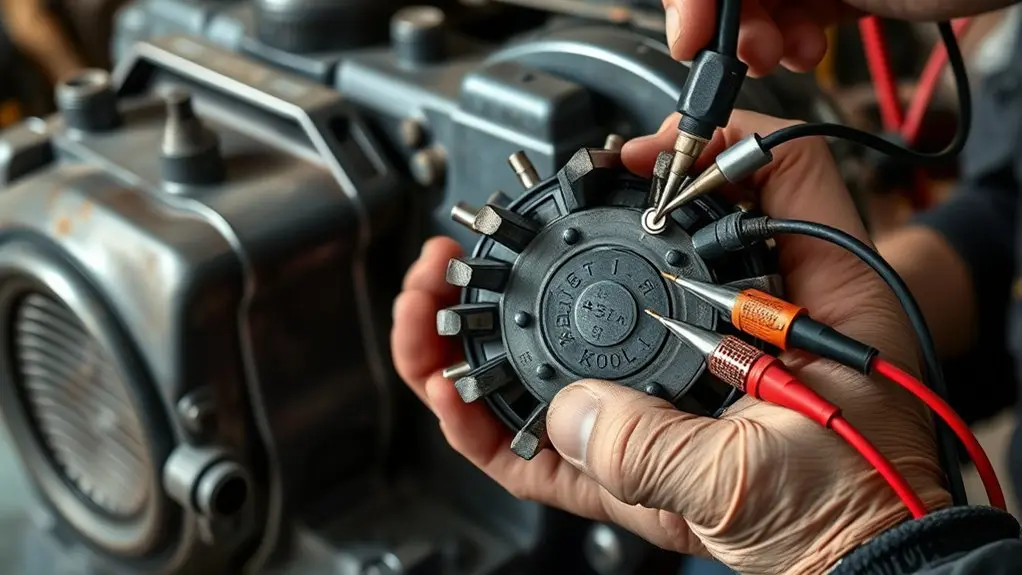
How do you guarantee your Kohler engine’s regulator is functioning properly? Start by inspecting all voltage regulator connections. Loose or corroded terminals can cause performance issues, so tighten screws and clean terminals as needed.
Next, make sure the regulator is properly grounded. Poor grounding leads to unstable voltage output.
Then, test the voltage output with the engine running. Aim for above 25 VAC for peak function.
Finally, watch for any corrosion or physical damage on the regulator that might signal failure.
Follow these steps:
- Check and tighten all regulator connections.
- Verify proper grounding to avoid electrical issues.
- Measure voltage output using quality multimeter leads.
- Inspect the regulator for corrosion or damage.
Interpreting Test Results and Troubleshooting Your Kohler Stator
Start by measuring the stator’s resistance with your multimeter, confirming the leads are disconnected from the rectifier regulator to get accurate readings. A good stator shows 0.2-0.3 ohms resistance.
Next, check voltage output while the engine runs; it should read between 25-50 VAC. Use the table below to interpret your results:
| Test Type | Expected Result | Troubleshooting Step |
|---|---|---|
| Resistance | 0.2-0.3 ohms | Replace if above 1 ohm |
| Voltage Output | 25-50 VAC | Inspect windings if lower |
| Resistance to Core | Infinite (no shorts) | Repair or replace if connected |
| Connectors | Clean, secure | Clean or tighten connections |
If resistance deviates or voltage is low, check for shorts and clean connectors to verify accurate readings and proper stator function.
Keeping Your Kohler Stator Running Smoothly
To keep your Kohler stator running smoothly, make it a habit to regularly check the connections and grounding. This helps you avoid any voltage drops that could cause trouble down the line.
You can also use a multimeter to keep an eye on resistance and voltage output. Doing this lets you spot any issues early before they turn into bigger problems.
Don’t forget to clean any corroded parts you find.
Plus, tracking your readings over time is a smart way to diagnose and prevent common problems before they cause a breakdown.
Stator Maintenance Tips
Although stators are built to last, you’ll need to regularly inspect connections and windings to keep your Kohler engine running smoothly.
Proper maintenance prevents electrical failures and guarantees reliable performance.
Follow these stator maintenance tips:
- Check all connections for wear, corrosion, or damage. Replace any worn parts immediately.
- Maintain insulation on windings to avoid shorts that can harm engine function.
- Clean corroded connectors to optimize voltage output and electrical reliability.
- Use a multimeter to record voltage output and perform resistance checks, making certain readings stay between 0.2 to 0.3 ohms for a 15 amp stator.
Staying consistent with these steps helps you spot issues early and extend your stator’s lifespan.
Diagnosing Common Issues
Keeping your Kohler engine running smoothly means catching stator issues early. Start by regularly checking the stator winding resistance with a multimeter.
For a 15 amp stator, readings between 0.2 and 0.3 ohms indicate it’s working properly.
Next, inspect the voltage regulator’s grounding. Corrosion or damaged connections can cause voltage drops and erratic engine behavior.
While the engine runs, measure the stator’s voltage output; you should see between 25 and 50 VAC across the leads.
Keep an eye on engine performance for irregularities, as persistent problems often point to stator faults needing immediate attention.
Finally, tap into community feedback online to learn common issues and troubleshooting tips. This can sharpen your diagnostic skills and help keep your Kohler stator in top shape.
Frequently Asked Questions
Can a Faulty Stator Cause Engine Starting Issues?
Yes, a faulty stator can cause engine starting issues.
If your stator isn’t producing enough voltage or has irregular outputs, it won’t properly trigger the ignition coil. That means your spark plug won’t fire correctly, leading to crank but no-start problems.
You might also notice dim lights or weak electrical accessories.
Testing the stator’s voltage output while cranking helps you pinpoint if it’s the cause of your starting troubles.
How Often Should I Replace the Stator on My Kohler Engine?
Think of your stator as the heartbeat of your Kohler engine; it needs regular checkups. You should replace it every 200-300 hours under normal conditions or sooner if you notice voltage drops or performance glitches.
For tougher jobs or harsh environments, swap it out every 100-150 hours to avoid surprises.
Always check your engine’s service manual to follow the manufacturer’s exact guidance and keep your engine running smoothly.
Are Aftermarket Stators Compatible With Kohler Engines?
Aftermarket stators can be compatible with Kohler engines, but you need to verify the exact model match.
Check specs like voltage output and resistance to confirm they meet OEM standards.
Keep in mind, some aftermarket parts may require modifications or different mounting hardware.
Read reviews for reliability, and be certain you understand the warranty and return policies before buying to avoid issues with defects or fitment.
What Tools Do Professionals Use for Advanced Stator Diagnostics?
You’ll want a digital multimeter with multiple ohm settings for precise resistance and voltage checks.
An oscilloscope helps you analyze voltage waveforms to spot subtle issues. Specialized stator testers simulate engine conditions, giving a full performance picture.
Use infrared thermometers to detect overheating, and high-voltage testers to verify insulation integrity.
These tools together guarantee you catch problems that basic testing might miss.
Can Weather Conditions Affect Stator Performance?
Imagine you’re running your Kohler engine during a rainy season, and suddenly it starts misfiring. Yes, weather can affect stator performance. Moisture can cause corrosion or shorts in the windings, reducing voltage output.
Extreme cold thickens oil, straining the stator, while heat can degrade insulation.
Conclusion
Testing your Kohler stator is like tuning a finely crafted instrument. Accuracy and care make all the difference.
By preparing your engine properly, using a reliable multimeter, and following safe measurement steps, you can quickly spot issues. Don’t forget to check the voltage regulator and connections. Loose wiring often causes problems.
With these straightforward tests, you’ll keep your stator running smoothly and avoid costly breakdowns. This ensures your engine performs at its best.