How To Check Compression On Kohler Engine – Full Tutorial
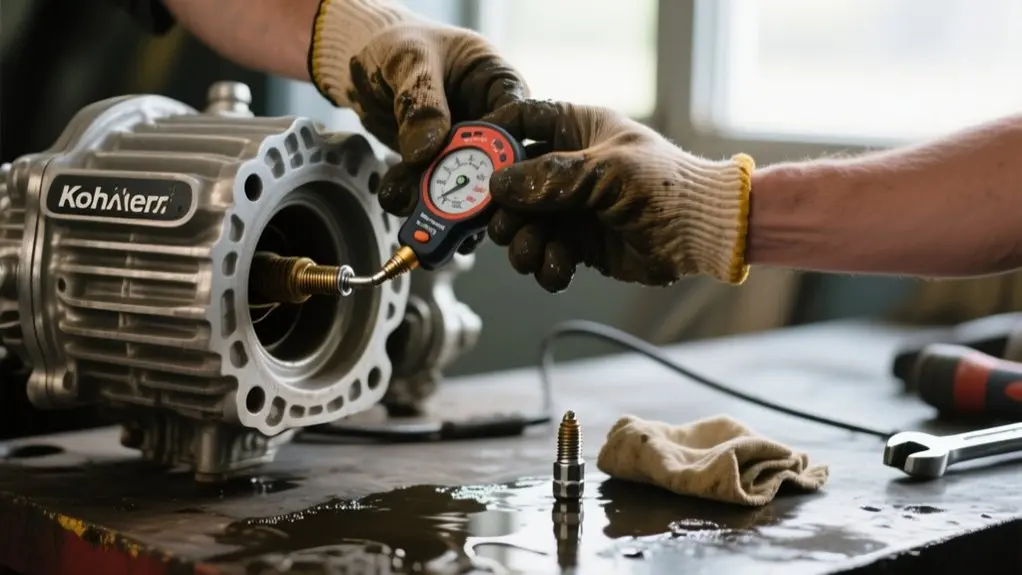
To check compression on your Kohler engine, first remove the spark plug and attach a compression gauge tightly. Make sure the throttle and choke are fully open, then crank the engine 4-6 times to get a pressure reading.
Healthy compression is usually 90-120 psi; below 60 psi indicates potential issues. You can also do a wet test by adding oil to the cylinder to pinpoint worn rings or valve problems.
Keep going to understand how to interpret these results and fix common issues.
When to Do a Compression Test on Your Kohler Engine
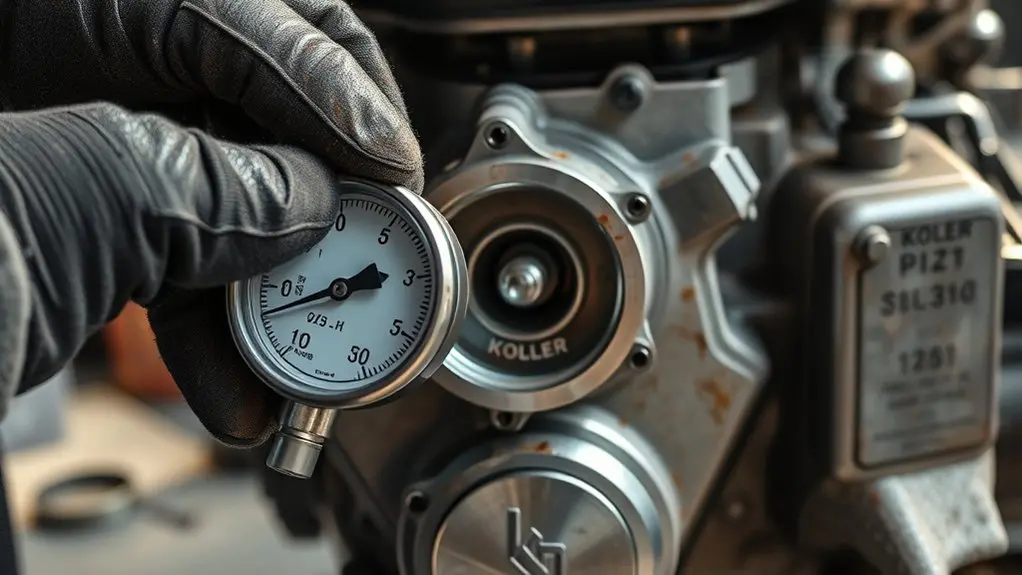
Before you perform a compression test on your Kohler engine, be certain you’ve ruled out fuel and ignition issues like bad spark plugs or stale fuel. Most no-start problems stem from these areas, so confirming your spark and fuel systems work properly helps you focus on the engine’s internals.
You should run a compression test on your hp Kohler if you experience hard starts, power loss, or excessive exhaust smoke. These symptoms often indicate mechanical issues that affect performance and longevity.
Run a compression test on your Kohler if you notice hard starts, power loss, or heavy exhaust smoke.
Conduct the test only after verifying your engine’s ignition and fuel systems function correctly. This guarantees your results accurately diagnose problems within the engine itself.
Doing this targeted evaluation prevents unnecessary repairs and helps keep your Kohler running smoothly.
Tools and Safety Gear for Compression Testing
Having the right tools and safety gear is essential when performing a compression test on your Kohler engine. You’ll need a compression gauge, preferably the screw-in type for accuracy, and the correct spark plug socket for easy removal.
Safety gloves protect your hands from hazards. An adapter might be necessary to fit the gauge properly. Keep your work area clear and organized to avoid accidents.
Make sure you understand how to use the tools safely for accurate results.
| Tool/Item | Purpose | Tip |
|---|---|---|
| Compression Gauge | Measures cylinder pressure | Use screw-in type for accuracy |
| Spark Plug Socket | Removes spark plug | Match size to your Kohler engine |
| Safety Gloves | Protects hands | Wear at all times during testing |
| Adapter | Fits gauge to spark plug hole | Check thread compatibility |
Preparing Your Kohler Engine for Compression Testing
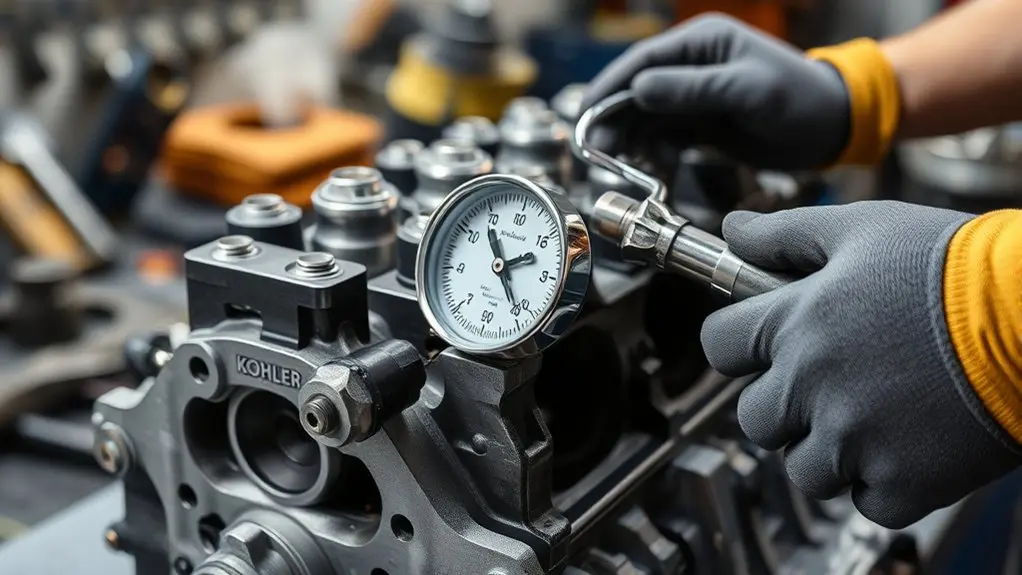
To get accurate compression readings on your Kohler engine, make certain it’s at operating temperature or test it cold if it won’t start. Before testing, prepare the engine properly to guarantee reliable results.
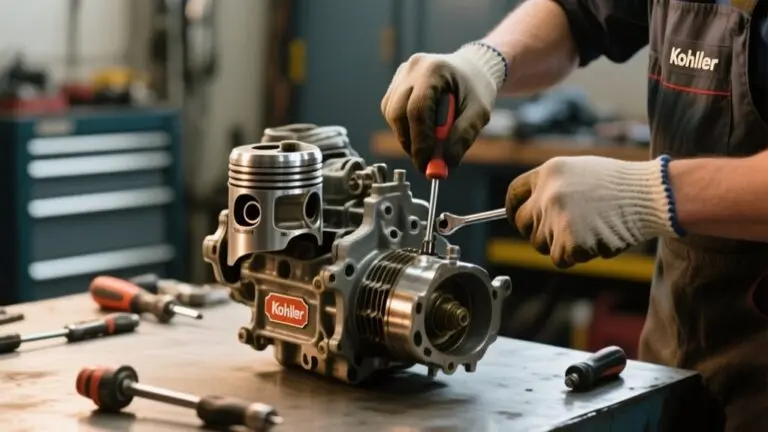
Start by disconnecting the spark plug lead and removing the spark plug with the right socket. This gives you access to the cylinder.
Then, ground the spark plug lead to avoid any accidental sparks during cranking. Finally, get your compression gauge ready by screwing it into the spark plug hole or using an adapter if needed.
Follow these steps to prepare your engine:
- Remove and ground the spark plug lead safely.
- Attach the compression gauge securely.
- Fully open the throttle and choke before cranking the engine 4-6 times.
How to Measure Compression on a Kohler Engine
To measure compression on your Kohler engine, start by properly preparing the engine and removing the spark plug.
Then, use a screw-in compression gauge to get an accurate reading. Make sure you fully open the throttle and choke before you begin cranking the engine.
Once you have the results, you’ll be able to interpret the numbers and spot any potential issues.
It’s a straightforward process that gives you a good idea of how your engine is performing.
Preparing Engine For Test
Before you start testing compression on your Kohler engine, make certain it’s warmed up for the most accurate readings unless it won’t start. In that case, you’ll test it cold. Preparing the engine properly helps guarantee you get reliable results.
Here’s what you need to do:
- Disconnect the spark plug lead and remove the spark plug using the correct socket. This gives you clear access to the cylinder.
- Ground the spark plug lead to prevent any electrical sparks during testing.
- Insert the compression gauge firmly into the spark plug hole, and open the throttle fully. This allows the engine to draw maximum air for an accurate compression reading.
Once prepped, you’re ready to proceed with the compression test.
Using Compression Gauge
Measuring compression on your Kohler engine involves using a compression gauge correctly to get an accurate reading.
First, warm up the engine if possible, or test it cold if it won’t start. Disconnect the spark plug lead and remove the spark plug using the correct socket.
Attach the compression gauge with a suitable adapter securely into the spark plug hole. Fully open the throttle and choke to allow maximum air flow.
Crank the engine for 4-6 revolutions while watching the gauge needle. The reading will indicate your engine’s compression pressure, typically between 90 and 120 psi for smaller Kohler engines.
Lower readings can signal worn rings or valves. Always verify the gauge is properly sealed to avoid inaccurate results during this process.
Interpreting Compression Results
Once you’ve cranked the engine and got your compression reading, you’ll want to interpret what those numbers mean for your Kohler engine’s health. Generally, healthy compression falls between 90 and 120 psi. If your reading is within this range, your engine is in good shape.
Here’s what to watch for:
- Above 90 psi: Healthy compression; engine components are functioning well.
- Below 60 psi: Indicates potential issues like worn piston rings or valve problems.
- Perform a wet test: Add a small amount of engine oil to the cylinder. If compression increases, piston rings are likely worn. If it stays the same, valves might be the problem.
Use these steps to diagnose your engine accurately and decide on necessary repairs or maintenance.
Understanding Compression Readings on a Kohler Engine
Although checking compression might seem straightforward, understanding the readings on your Kohler engine is key to diagnosing its health. For a 14 hp Kohler engine, you should expect compression between 90 and 120 psi for peak performance.
If your readings fall below 60 to 80 psi, you’re likely facing serious mechanical issues like worn piston rings or a failing head gasket. It’s important to compare readings across all cylinders. Significant differences could signal a problem in one area.
These values directly affect how well your engine starts and runs. Keep in mind, if you get low compression, you’ll want to perform further testing to pinpoint the cause, but that’s a topic for the next step in this tutorial.
Performing the Wet Compression Test to Diagnose Rings vs. Valves on a Kohler Engine
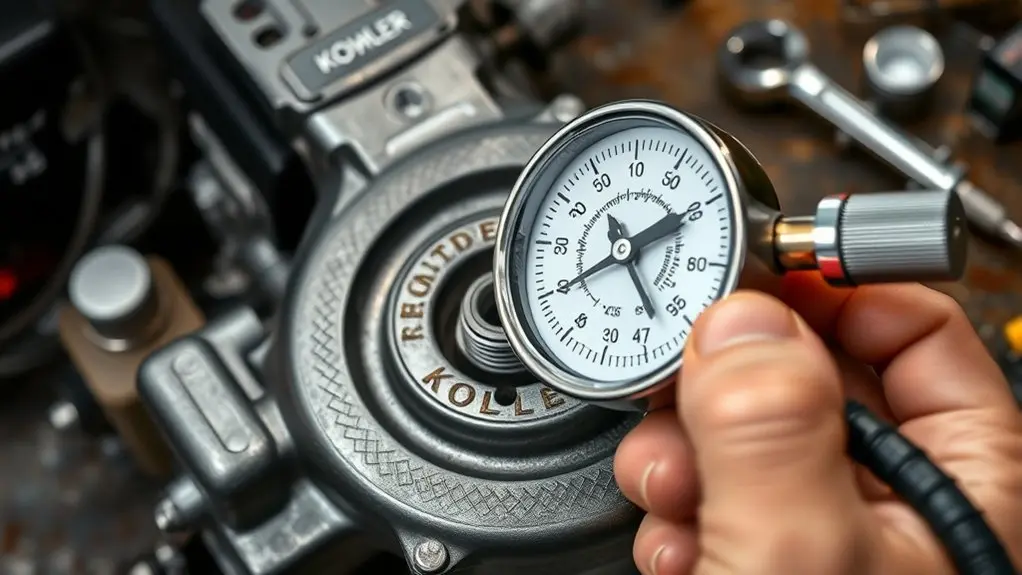
To pinpoint whether worn piston rings or valve issues are causing low compression on your Kohler engine, you’ll perform a wet compression test.
Start by completing a dry compression test to get baseline readings. Then, add a small amount of engine oil into the cylinder through the spark plug hole. Next, retest the compression and compare the results.
Here’s what to look for:
- If compression increases noticeably, worn piston rings are likely the problem, as oil temporarily seals the gaps.
- If compression doesn’t improve, the issue is probably with the valves or head gasket.
- Always verify the engine is warm and follow safety precautions during testing.
This method helps you accurately diagnose the cause of low compression.
What Low Compression Means on a Kohler Engine: And How to Fix It
Understanding low compression on your Kohler engine is key to diagnosing mechanical problems that affect performance. Low compression, usually below 90 psi, often points to worn piston rings, valve issues, or a blown head gasket.
Low compression below 90 psi often indicates worn rings, valve problems, or a blown head gasket.
Before testing compression, rule out fuel and ignition problems, especially if your engine won’t start or produces excessive smoke.
If you find low compression, perform a wet test by adding oil to the cylinder. If compression rises, the piston rings likely need attention; if it doesn’t, check the valves.
Regular maintenance, like cleaning the carburetor, helps prevent compression loss.
Fixing low compression may require repairing internal parts or, in severe cases, rebuilding the engine. Tackling these issues promptly will restore your engine’s power and reliability.
Frequently Asked Questions
Can I Use Any Compression Gauge for a Kohler Engine?
You can use many compression gauges on a Kohler engine, but it’s best to pick one with a screw-in adapter that matches the spark plug thread size for an accurate fit.
Make sure the gauge measures pressures within the typical Kohler range (90-160 psi) and offers clear readings.
Checking your specific model’s recommended compression specs helps you choose the right gauge and get reliable results when diagnosing engine health.
How Often Should I Perform Compression Tests on My Kohler Engine?
Think of your Kohler engine like a heartbeat. You want to check its pulse regularly. You should perform compression tests every 100 hours of use or at least once a year.
If your engine struggles to start, loses power, or smokes too much, test sooner. Regular checks help you catch problems early, keeping your engine running strong and saving you costly repairs down the road.
Don’t wait until trouble shows up.
Does Altitude Affect Kohler Engine Compression Readings?
Yes, altitude does affect your Kohler engine’s compression readings. As you go higher, the air gets thinner, lowering atmospheric pressure and causing compression to drop by about 3-5 psi at 5,000 feet or more.
This leaner air-fuel mix can impact performance and test results.
Keep altitude in mind when checking compression, and be ready to adjust your carburetor and ignition timing for the best engine operation.
Can Fuel Type Impact Compression Test Results?
Yes, fuel type can impact your compression test results. Using high-octane fuel prevents knocking and guarantees consistent combustion, which helps get accurate readings.
Stale or contaminated fuel can cause incomplete combustion and carbon buildup, leading to lower compression due to ring or valve issues.
Always use fresh, clean fuel with the right formulation to avoid misleading compression results and get a true sense of your engine’s health during testing.
What Are Signs of a Faulty Compression Gauge?
If your compression gauge shows wildly fluctuating or zero pressure on a healthy cylinder, it’s likely faulty.
Imagine squeezing a balloon with a hole—that’s what a leaking gauge does, causing low readings.
Also, if the gauge never reaches expected pressure despite proper engine condition, it’s probably damaged.
Don’t forget, uncalibrated gauges can mislead you, so regular calibration is key to accurate diagnostics.
Conclusion
Now that you know how to check compression on your Kohler engine, you’re ready to spot problems before they slow you down. Funny how a simple test can save you from big repairs, right?
By staying sharp with these easy steps, you’ll keep your engine running strong and avoid surprises. So grab your tools, follow the guide, and get that perfect compression reading. It’s your engine’s health check that pays off every time.