How Long Does A Kohler Generator Last – Numbers to Know
You can expect a Kohler generator to last between 25 and 40 years with proper maintenance, delivering around 3,000 operational hours before significant repairs arise. Environmental factors like humidity and temperature and consistent servicing every 100 hours greatly influence its lifespan.
Watch for warning signs such as unusual noises or power drops to avoid costly failures. If you want to understand how maintenance routines, replacement indicators, and technological advances impact longevity, there’s more to explore.
Typical Lifespan Range for Kohler Generators
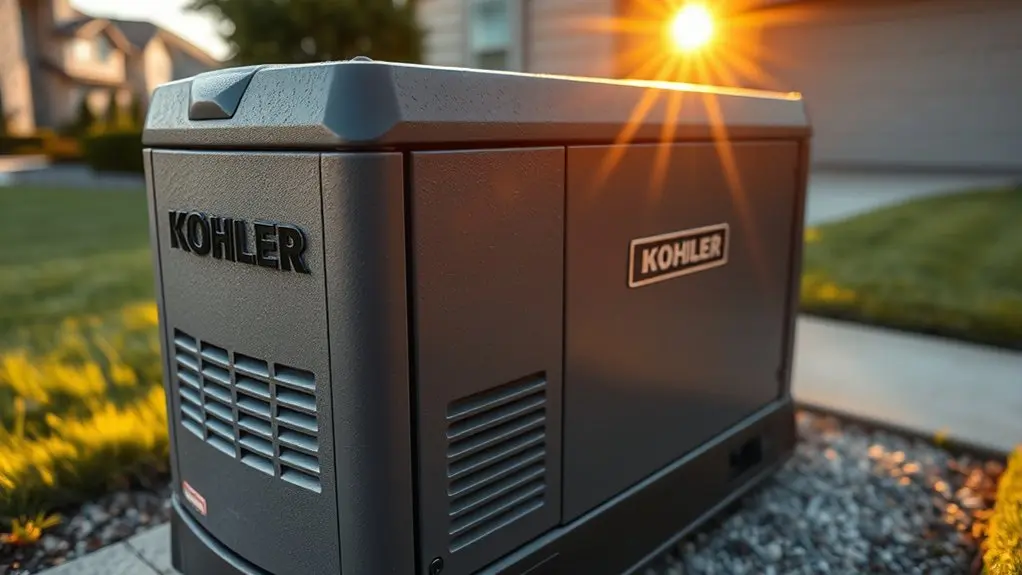
A Kohler generator typically lasts between 25 and 40 years when you maintain it properly.
Kohler generators are engineered for competitive longevity, ensuring a reliable backup power system over decades. Their operational lifespan depends heavily on a consistent maintenance routine.
Regular maintenance maximizes reliability and prevents premature wear. By adhering to manufacturer-recommended servicing schedules, you can achieve around 3,000 continuous operational hours, equivalent to approximately 125 days of use.
This durability directly enhances the return on investment, as fewer replacements and repairs are necessary. Compared to other brands, Kohler’s lifespan outperforms many competitors, making it a preferred choice for long-term power reliability.
If you prioritize regular upkeep, your Kohler generator will sustain peak performance throughout its expected lifespan, securing your home’s energy needs efficiently.
Factors Affecting Kohler Generator Lifespan
You’ll find that environmental conditions like humidity, temperature extremes, and dust exposure directly impact your Kohler generator’s durability.
And it’s not just the environment—how often you run the generator matters a lot too.
Continuous operation can speed up mechanical wear.
Environmental Impact
Although Kohler generators are engineered for durability, their lifespan between 25 to 40 years depends heavily on environmental conditions. Environmental factors like salt corrosion in coastal areas accelerate wear, requiring more frequent inspections and servicing to maintain ideal performance.
High humidity promotes internal component degradation and electrical faults, demanding targeted maintenance strategies. Temperature extremes impose mechanical stress, shortening engine component life and necessitating rigorous checks.
Furthermore, the fuel type, natural gas or propane, affects maintenance protocols and generator longevity due to combustion characteristics and residue buildup.
To maximize your Kohler generator’s lifespan, you must tailor maintenance schedules to these variables, focusing on corrosion prevention, humidity control, and temperature management.
Regular, precise servicing aligned with environmental challenges guarantees sustained reliability and operational efficiency.
Usage Frequency
Environmental conditions certainly influence your Kohler generator’s durability, but how often you run the unit plays an equally significant role in determining its lifespan. Usage frequency directly impacts wear and tear; more frequent operation accelerates component degradation, reducing overall lifespan.
For ideal performance, you must adhere to regular maintenance schedules, including servicing every 100 hours of operation.
During extended outages, continuous operation demands increased attention to maintenance to sustain reliability.
Neglecting servicing under heavy usage can lead to premature failure, especially when environmental factors like extreme temperatures make parts work harder.
How Environmental Conditions Impact Durability
You’ll find that high humidity speeds up corrosion and wears down electrical components in Kohler generators, which means you’ll need to do maintenance more often.
On the other hand, extreme temperatures—whether it’s really hot or really cold—put extra stress on the internal parts and can lower how efficiently the generator works over time.
When you understand these environmental effects, it’s easier to come up with a plan that helps get the most out of your generator’s lifespan.
Humidity Effects On Generators
When operating a Kohler generator in high-humidity conditions, you must address the accelerated corrosion and moisture buildup that can degrade critical components.
Humidity promotes rusting, especially in coastal environments, leading to moisture-related failures in electrical parts.
To maintain performance and maximize longevity, you’ll need targeted generator maintenance, including enhanced ventilation to reduce moisture accumulation.
Regular inspections are vital for early detection of corrosion and potential damage, allowing timely interventions.
Without these measures, the reliability of Kohler generators declines, and repair costs increase.
Implementing strict maintenance protocols tailored to humidity levels helps mitigate risks, preserving the generator’s operational integrity.
Fundamentally, controlling environmental moisture through ventilation and consistent inspections directly supports the durability and extended lifespan of your Kohler generator in humid settings.
Temperature Extremes And Lifespan
Although Kohler generators are engineered to perform reliably across a range of temperatures, extreme heat or cold can considerably affect their durability and functionality. In high-temperature environments, overheating accelerates wear on critical components, reducing lifespan and increasing the frequency of maintenance.
Conversely, cold conditions impair fuel system performance and decrease battery efficiency, which can delay generator startup during outages.
Moreover, temperature extremes exacerbate corrosion risks, especially in humid or coastal areas, demanding vigilant inspections and tailored maintenance schedules.
To maximize your Kohler generator’s operational life, you must prioritize regular inspections and proactive maintenance focused on mitigating the effects of temperature extremes.
Addressing overheating, wear, and system efficiency ensures consistent reliability and extends the overall lifespan under challenging environmental conditions.
How Regular Maintenance Extends Kohler Generator Life
Because regular maintenance addresses critical wear points and system vulnerabilities, it directly extends the operational life of your Kohler generator. Kohler generators can last 25 to 40 years when you follow scheduled annual servicing, oil changes every 100 hours, and routine inspections. This approach not only enhances reliability but also guarantees compliance with manufacturer warranty requirements and peak operation during outages.
| Maintenance Task | Impact on Generator Life |
|---|---|
| Annual servicing | Detects early faults |
| Oil changes | Prevents engine wear |
| Routine inspections | Identifies fuel/electrical issues |
| Battery checks | Maintains starting reliability |
| Filter replacements | Guarantees clean fuel/air supply |
Regular maintenance is essential to extend life and maximize your generator’s efficiency and reliability.
How to Tell When Your Kohler Generator Needs Service or Replacement
How do you know if your Kohler generator requires service or replacement?
Start by monitoring warning lights and unusual noises; these are clear indicators that service is needed.
If the generator fails to start or can’t deliver adequate power during outages, you must schedule immediate maintenance.
Keep track of runtime—exceeding about 3,000 hours strains the system and shortens longevity.
Regular annual maintenance optimizes performance and extends life, but persistent issues despite service appointments suggest that replacement might be necessary.
Pay attention if your generator is over 25-30 years old without major upgrades, as aging components compromise reliability.
When and Why to Replace Your Kohler Generator
When your Kohler generator starts showing signs of consistent failure to start or diminished power output despite regular maintenance, it signals that replacement should be considered.
Kohler generators typically last 25 to 40 years, but if repair costs exceed 50% of a new unit’s price or your energy demands surpass the generator’s power load, upgrading is more economical.
Modern models offer advancements in fuel efficiency and quieter operation, enhancing overall performance.
| Condition | Indicator | Action |
|---|---|---|
| Frequent start failure | Consistent outage issues | Consider replacement |
| High repair cost | Repairs >50% of new generator | Replace |
| Insufficient power | Can’t meet energy demands | Upgrade to new unit |
| Outdated technology | Lower fuel efficiency, noise | Invest in new model |
Frequently Asked Questions
What Types of Fuel Do Kohler Generators Use?
Kohler generators primarily use natural gas or propane as fuel sources.
You’ll find natural gas convenient if you have a continuous supply through utility lines, which is ideal for whole-house backup.
Propane, stored in tanks, suits locations without natural gas access and offers portability.
Each fuel type affects maintenance and performance differently, so you’ll need to adjust service schedules accordingly.
Both fuels burn cleanly, reducing emissions compared to diesel alternatives.
Are Kohler Generators Compatible With Smart Home Systems?
Just like Tony Stark’s JARVIS, Kohler generators are compatible with smart home systems. You can integrate them via compatible transfer switches and control them through the Kohler Energy Management App.
This lets you monitor performance, schedule maintenance, and get real-time alerts directly on your smart devices.
The seamless integration enhances energy efficiency and guarantees your generator responds intelligently during outages, giving you precise control and peace of mind.
How Noisy Are Kohler Generators During Operation?
Kohler generators typically operate between 60 and 70 decibels, which you can compare to normal conversation or a vacuum cleaner’s noise.
Depending on the model and installation, noise levels might vary slightly.
Kohler incorporates sound-dampening technology to keep operation quieter, and advanced setups like weather enclosures can further reduce noise emissions.
You’ll find the sound generally manageable, though larger units may produce louder noise levels due to their increased capacity.
Can Kohler Generators Power an Entire Household?
Absolutely, you can rely on Kohler generators to power your entire household.
Like a trusty pocket watch in a digital age, their capacity, ranging from 14KW to 60KW, matches various home demands precisely.
They handle essential systems including HVAC and medical devices without interruption.
With advanced load banking tests, you’ll know they can sustain your total electrical load efficiently, ensuring seamless power during outages with technical reliability and performance.
What Safety Features Come Standard With Kohler Generators?
Kohler generators come standard with automatic low oil shutdown, which prevents engine damage by stopping operation when oil is low.
They include over-speed protection that halts the generator if RPMs exceed safe limits.
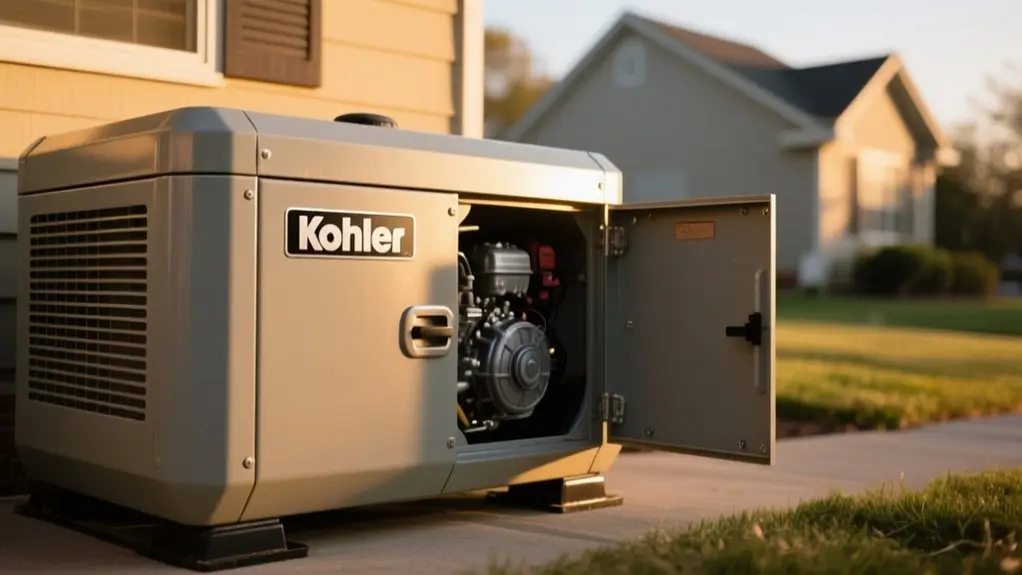
You’ll also get an extensive monitoring system alerting you to potential issues, built-in surge protection to safeguard appliances, and a weatherproof enclosure protecting internal components from environmental damage.
These features guarantee reliable, safe operation under various conditions.
Conclusion
You can expect your Kohler generator to perform reliably for 20 to 30 years if you maintain it properly and take into account environmental factors. Neglecting upkeep is like letting rust quietly eat away at metal, gradual but destructive.
By monitoring performance indicators and scheduling timely service, you’ll maximize its lifespan and avoid unexpected failures. When repairs become frequent or efficiency drops markedly, it’s time to think about replacement to guarantee uninterrupted power supply.